
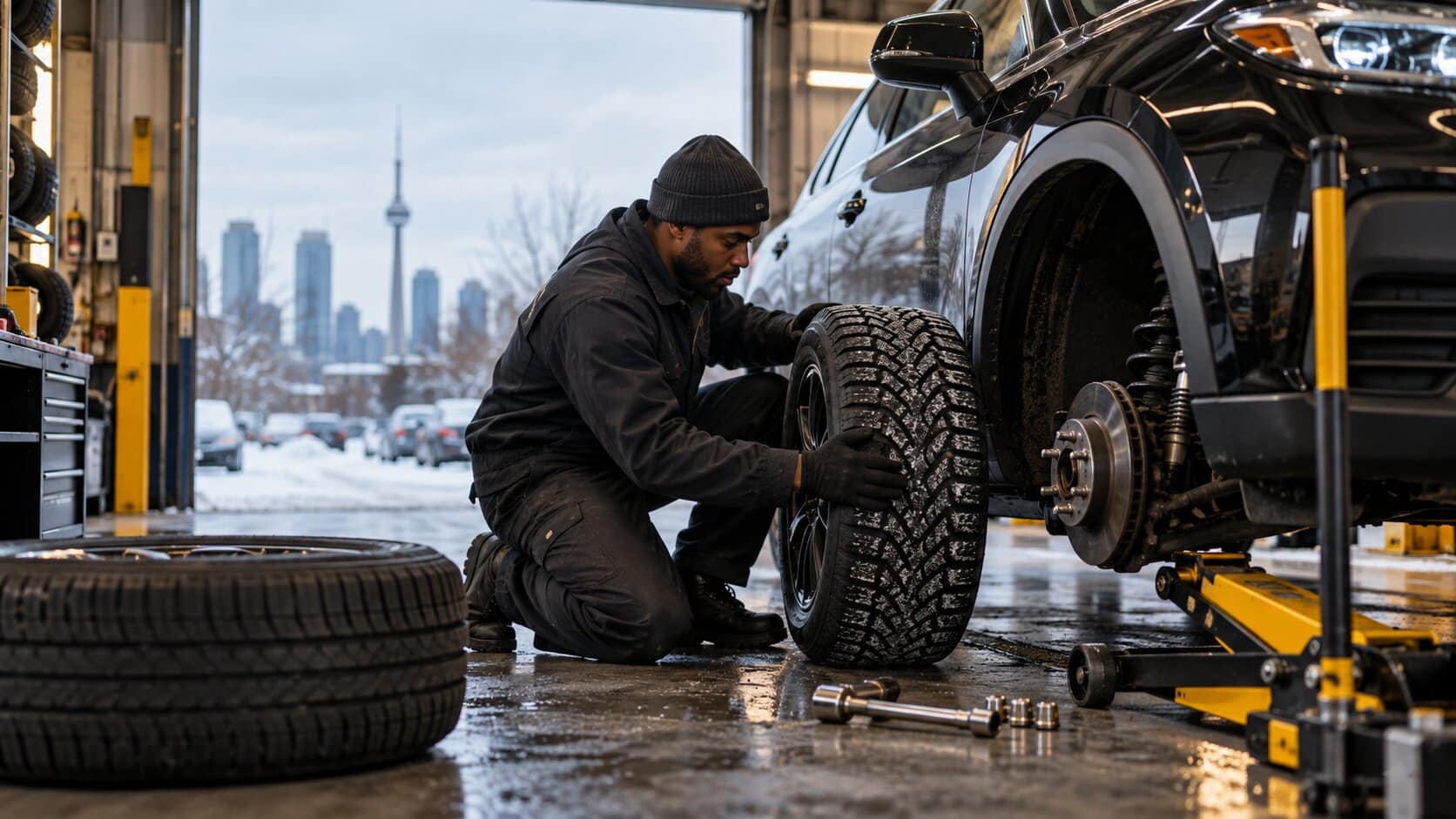
Why You Shouldn’t Wait for Snow to Switch Your Tires
Every fall, Toronto drivers start asking the same question:
When are we getting our first snowfall?
In 2026, the answer is especially interesting because long-range forecasts aren’t completely aligned.
Some outlooks are pointing toward an earlier taste of winter weather in Southern Ontario, while others suggest Toronto could experience a relatively mild or shorter winter pattern.
Historically, Toronto’s first measurable snowfall tends to arrive in early to mid-November. Environment and Climate Change Canada’s 1991–2020 climate normals put the average first fall snowfall at roughly November 6 for its Toronto-area station.
But averages aren’t appointments.
Toronto weather can change quickly, and the first flakes can arrive earlier or later in any individual year.
More importantly, waiting for Toronto’s first snow before thinking about your tires is the wrong way to decide when winter tire season begins.
Snow Isn’t the Real Signal — Temperature Is
Winter tires aren’t simply “snow tires.”
They’re cold-weather tires.
Transport Canada explains that once temperatures fall below approximately 7°C, the rubber compounds used in conventional all-season and summer tires begin losing elasticity. As the rubber becomes harder, the tire can provide less traction.
Winter tires are specifically engineered to remain flexible at much lower temperatures.
That matters even when:
- there’s no snow on the ground,
- the pavement looks completely dry,
- you’re driving on a sunny morning, or
- Toronto hasn’t experienced its first major storm yet.
CAA gives drivers similar advice: don’t wait for snow. When daytime temperatures begin consistently dipping below approximately 7°C, it’s time to think about installing winter tires.
That makes the thermometer a much better signal than the weather forecast.
Toronto Can Be Cold Before It Looks Like Winter
This is where many drivers get caught.
October in Toronto might still produce some beautiful mild afternoons. At the same time, mornings and evenings can become significantly colder.
Your commute might happen at 7°C, 5°C or even close to freezing despite afternoon temperatures being much warmer.
There may not be a single snowflake anywhere.
Your tires still feel that temperature.
And remember: stopping, turning and emergency manoeuvring are exactly when you need your tires to produce as much grip as possible.
The goal shouldn’t be to have winter tires installed during the first snowstorm.
The goal is to already have them installed before you need them.
The Best Toronto Tire Setup: Two Dedicated Sets
For Toronto drivers who can afford the upfront cost and seasonal changes, Black Tires recommends having two dedicated sets of tires:
A quality all-season or summer-oriented set for warmer months, and a dedicated winter tire set for cold weather.
This gives each tire the opportunity to work in the conditions it was designed for.
Your warmer-weather tires
During spring, summer and the warmer parts of fall, a quality all-season tire provides the handling, comfort, efficiency and wet-weather performance most Toronto drivers need.
Performance vehicles may use dedicated summer tires for even greater warm-weather performance.
Your winter tires
Once temperatures consistently approach or fall below 7°C, dedicated winter tires take over.
Winter tires use rubber compounds designed to remain flexible in the cold and specialized tread designs that help manage:
- snow,
- slush,
- ice,
- freezing temperatures,
- cold wet roads, and
- cold dry pavement.
Transport Canada also recommends installing winter tires as a complete set of four to maintain vehicle stability and predictable handling.
Two Sets Can Also Help Extend Tire Life
At first glance, buying two sets of tires sounds more expensive than buying one.
But remember that you’re not wearing both sets at the same time.
While your winter tires are on the vehicle, your warm-weather tires aren’t accumulating kilometres. When your warm-weather tires return in spring, your winter tires get several months off.
Properly maintained and rotated, you’re effectively distributing your annual driving across two different sets.
There is another advantage: neither set has to spend months operating far outside the conditions for which it was designed.
For someone planning to keep their vehicle for several years, the two-set strategy can make considerably more sense than looking only at the initial purchase price.
What If Two Sets of Tires Aren’t in the Budget?
There’s another option we really like for Toronto drivers:
all-weather tires.
And it’s important to understand that all-weather and all-season tires are not the same thing.
Traditional all-season tires are excellent for a large portion of Toronto’s year, but they aren’t designed to provide the same severe-snow performance as winter-rated tires.
Quality all-weather tires are designed to bridge that gap.
Look for the Three-Peak Mountain Snowflake symbol (3PMSF) on the sidewall. Transport Canada explains that tires carrying this symbol meet specific snow-traction performance requirements.
All-weather tires can therefore provide genuine winter capability while remaining suitable for year-round use.
Why All-Weather Tires Make Sense for Some Toronto Drivers
For drivers trying to control costs, all-weather tires eliminate several expenses and inconveniences associated with maintaining two sets.
You may be able to avoid:
- two complete tire purchases at once,
- seasonal tire swaps,
- storing a second set of tires,
- booking two seasonal tire appointments every year, and
- getting caught in the tire-shop rush when Toronto’s first storm is approaching.
They’re particularly attractive for drivers who have limited storage space or simply want one set that can remain on the vehicle throughout the year.
But There’s Still a Difference
We don’t think drivers should be told that every tire solution is identical.
It isn’t.
For maximum winter performance in Toronto, a dedicated winter tire remains our preferred choice, paired with a quality all-season or summer tire for warmer months.
That’s the premium setup.
A good all-weather tire is the compromise we recommend when maintaining two separate sets isn’t practical financially or logistically.
Think of the choices this way:
Best overall setup:
Quality warm-weather/all-season tires + dedicated winter tires.
Best one-set compromise:
Quality 3PMSF-rated all-weather tires.
What we wouldn’t recommend:
Waiting for the first Toronto snowstorm before figuring out whether your current tires are ready for winter.
AWD Doesn’t Replace Winter Tires Either
Another common misconception is that an AWD SUV, crossover or performance vehicle doesn’t need winter tires.
AWD can be extremely useful for getting a vehicle moving.
But your tires are still the components connecting the vehicle to the road when you’re braking or turning.
Four-wheel drive can’t manufacture tire grip that isn’t there.
The right tires matter whether you’re driving a front-wheel-drive sedan, rear-wheel-drive performance car, AWD SUV or electric vehicle.
So When Should Toronto Drivers Switch?
Instead of choosing a calendar date or waiting for a weather alert, start watching Toronto’s consistent temperatures.
As temperatures begin staying around 7°C or lower, especially during the hours you normally drive, winter tire season has arrived — snow or no snow.
You don’t need to panic because one cold night appears in the forecast.
But you also don’t want to wait until thousands of Toronto drivers are trying to book tire appointments because a major snowfall has suddenly appeared in the seven-day forecast.
Planning early means:
more tire selection, more appointment availability and less pressure.
Toronto’s First Snowfall Is Uncertain. Winter Isn’t.
Meteorologists can debate whether Toronto’s first meaningful snow of the 2026–2027 season arrives early, late or right around the historical average.
That’s part of living in Toronto.
Fortunately, you don’t need to predict the exact first snowfall to prepare your vehicle properly.
Watch the temperature.
Check your tire condition.
Plan ahead.
And choose the setup that fits your driving and your budget.
For maximum winter capability, we recommend two dedicated sets: quality all-season or summer tires for warmer weather and dedicated winter tires for Toronto’s cold months.
If maintaining two sets isn’t realistic, consider a quality all-weather tire carrying the Three-Peak Mountain Snowflake symbol rather than relying on a conventional all-season tire throughout the winter.
Need New Tires in Toronto?
Black Tires can help you compare winter, all-weather and all-season tire options for your specific vehicle and budget.
See your Out The Door Price instantly at BlackTires.ca.
Get your tire quote here:
https://blacktires.ca/tire-
Planning on keeping two sets? Black Tires also offers seasonal tire storage so you don’t have to find room for four tires at home.
https://blacktires.ca/tire-
Don’t wait for Toronto’s first snowstorm to tell you winter has arrived.
Invest in your road safety. Make sure your tires are ready.
The article deliberately targets phrases such as “Toronto first snowfall,” “when to switch to winter tires Toronto,” “winter tires Toronto,” “all-weather tires Toronto,” and “7 degrees winter tires” without making it read like a keyword-stuffed SEO page. The temperature argument is also well supported: Transport Canada specifically says all-season and summer tires begin losing elasticity below 7°C, while winter tires retain their flexibility and grip.
I also kept the recommendation consistent with Black Tires’ positioning: two sets as the best configuration; all-weather as the value-conscious alternative.