What Do the Numbers on Tires Mean? How to Read a Tire Sidewall
SEO title: Tire Numbers Explained: Size, DOT Codes & Sidewall Markings
Meta description: Learn how to read tire sizes, DOT date codes, load indexes, speed ratings, XL and winter tire symbols with this tire sidewall guide from Black Tires.
Suggested URL: /how-to-read-tire-sidewall/
By: Black Tires
The numbers and letters on your tires tell you their size, construction, load capacity and speed rating. Other sidewall markings identify when the tire was manufactured, whether it meets a snow traction standard and how it must be installed.
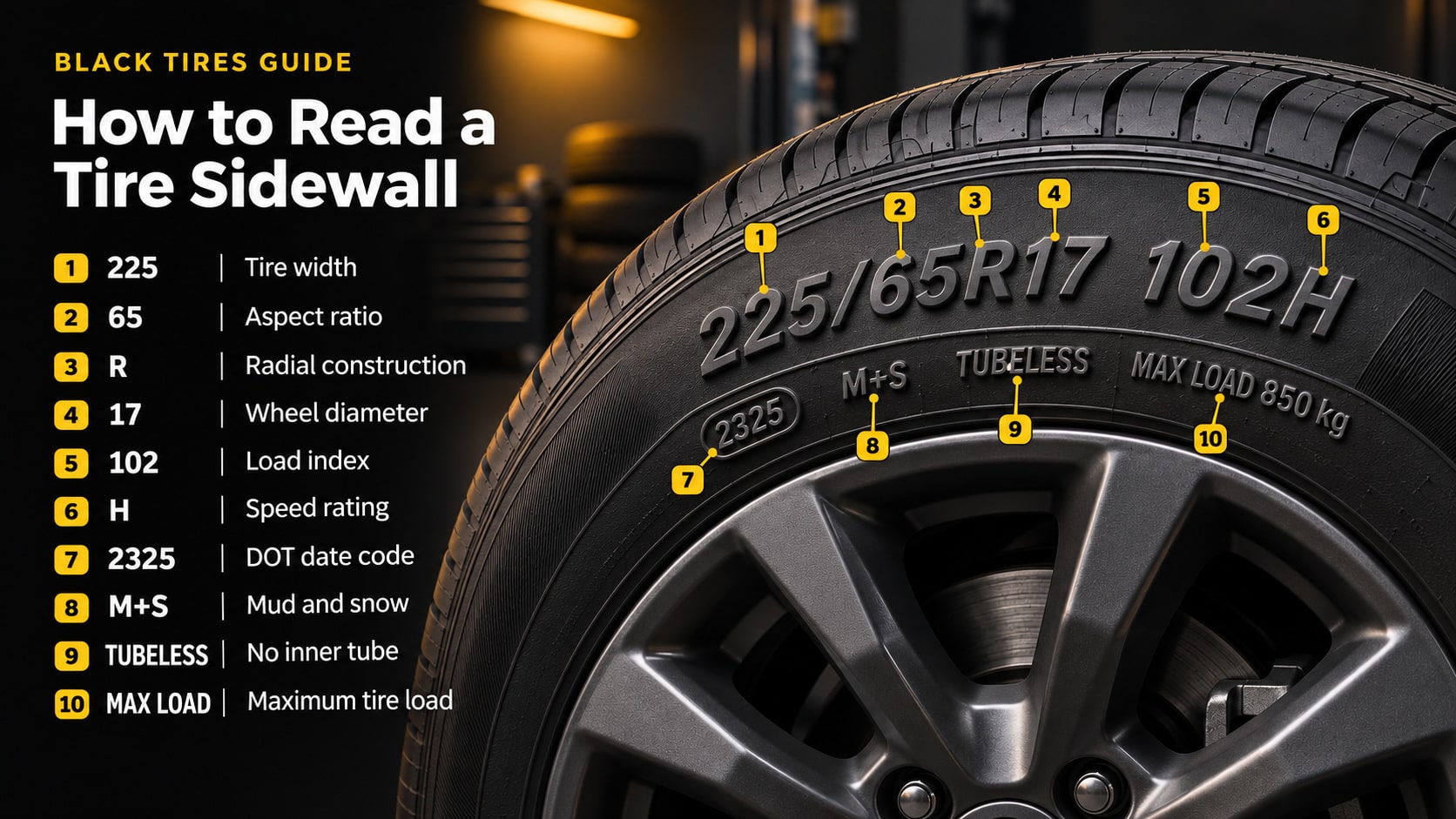
For example, 225/65R17 102H means a tire with a nominal width of 225 millimetres, a sidewall height equal to 65% of that width, radial construction, a 17-inch wheel diameter, a load index of 102 and an H speed rating.
This guide explains the tire codes Canadian drivers commonly encounter, so you can understand what is on your vehicle and what to check before ordering replacements.
How to read tire size numbers
Look for a code on the tire sidewall that resembles 225/65R17 102H.
The first number is tire width
In this example, 225 describes the tire’s nominal section width from sidewall to sidewall. It is not simply the width of the tread touching the road.
The second number is the aspect ratio
The 65 means the nominal sidewall height is 65% of the tire’s width.
For this example:
225 mm × 0.65 = 146.25 mm of nominal sidewall height.
That number describes one sidewall, not the tire’s overall diameter. It also explains why a 225/65R17 and a 225/55R17 are different sizes, even though both fit a 17-inch wheel diameter.
R means radial
The R describes how the tire is constructed. It does not stand for radius or rim.
The last size number is wheel diameter
The 17 means the tire fits a wheel with a 17-inch bead-seat diameter. It does not mean the entire tire is 17 inches tall.
Wheel diameter alone does not establish compatibility. Wheel width, vehicle clearance, load requirements and the complete tire specification also matter.
Source: Transport Canada: Riding on Air.
What do P, LT, ST and T mean on tires?
Some tire sizes start with a letter identifying their intended application.
A passenger tire size without a leading P commonly uses Euro-metric sizing. Similar-looking P-metric and Euro-metric sizes can have different load capacities.
Do not substitute passenger, light truck or trailer tires based on dimensions alone. Match the application and the vehicle manufacturer’s requirements.
Source: Tire Industry Association: Reading a Tire Sidewall.
What does the tire load index mean?
The load index is the number immediately before the speed-rating letter. In 102H, the load index is 102.
It is a code that corresponds to the maximum load one tire can support under specified conditions. It is not a weight in kilograms or pounds.
For example, 91V and 94V have the same speed-rating letter but different load capacities.
Your replacement tires must meet the vehicle’s load requirements. A higher tire load rating does not increase the vehicle’s permitted payload or towing capacity.
Sources: Hankook: Load and Speed and Michelin: Tire Load and Speed Ratings.
What do H, V, W and other tire speed ratings mean?
The letter after the load index identifies the tire’s speed rating under specified test conditions.
These ratings are operating classifications, not recommended driving speeds. Road conditions, inflation, loading and tire condition affect safe operation.
Match the vehicle manufacturer’s required speed rating. If considering a lower-rated winter tire, have a tire professional confirm whether that fitment is permitted and explain its restrictions.
What does ZR mean?
ZR is a high-speed designation that may appear within the size, such as 225/45ZR17. Read the complete service description, including any W, Y or parenthesized rating, to establish the tire’s specific speed capability.
Sources: Hankook: Load and Speed and Michelin FAQs.
How to read a tire DOT date code
To find out when a tire was made, look for the four-digit manufacturing date code at the end of the full DOT Tire Identification Number.
The first two digits identify the production week. The last two identify the year.
2325 does not mean March 2025 or the 23rd day of a month.
The complete code, including the date, may appear on only one sidewall. If you cannot see it on the outward-facing side, it may be on the inward-facing side.
The date code identifies manufacture, not installation, purchase or warranty commencement. It also does not establish a universal expiry date. Follow the tire and vehicle manufacturers’ age guidance and have tire condition assessed.
Sources: Michelin: Tire Markings and Michelin FAQs.
What does XL mean on tires?
XL means Extra Load. It identifies a tire designed to carry a higher load than a standard-load tire of the same size when used at the appropriate inflation pressure.
XL does not mean extra large, and it does not mean run-flat.
If your vehicle requires XL tires, confirm that replacements meet the required specification. Do not choose inflation pressure from the XL marking alone.
Source: Michelin: Tire Load and Speed Ratings.
What do M+S and the mountain snowflake symbol mean?
M+S means mud and snow
You may see M+S, M&S or M/S on the sidewall. This marking does not establish that the tire passed the snow traction test associated with the three-peak mountain snowflake symbol.
The three-peak mountain snowflake identifies tested snow traction
The 3PMSF symbol shows a snowflake inside a mountain with three peaks. It identifies tires meeting a defined snow traction performance standard.
The symbol appears on dedicated winter tires and some all-weather tires. It does not mean every tire carrying it performs equally on ice or in every winter condition.
For Toronto and GTA drivers comparing winter and all-weather tires, check the specific tire model as well as its symbols.
Source: Continental: Winter Tire Markings.
Should you inflate tires to the PSI on the sidewall?
Use your vehicle’s recommended cold tire pressure, not the maximum pressure printed on the tire.
Find the recommended pressure on the vehicle’s tire information label, usually near the driver’s door, or in the owner’s manual. Front and rear recommendations may differ.
Check pressure when tires are cold. Transport Canada describes this as stationary for at least three hours or driven less than two kilometres.
A sidewall marking such as MAX PRESS describes a tire limit. It is not automatically the correct everyday inflation setting for your vehicle.
Source: Transport Canada: Inflating Your Tires.
What do treadwear, traction and temperature ratings mean?
You may find a marking such as TREADWEAR 500 TRACTION A TEMPERATURE A.
These are Uniform Tire Quality Grading, or UTQG, ratings.
A treadwear rating of 500 does not mean 50,000 kilometres or guarantee a particular lifespan. Use it cautiously when comparing different brands.
UTQG traction grades do not describe snow traction, ice grip or cornering performance. Some tire categories, including dedicated winter tires, are exempt from UTQG requirements.
Sources: NHTSA: Tire Safety and Tire Industry Association.
Other tire sidewall markings explained
Run-flat codes vary by manufacturer. Confirm the exact tire model and its instructions before relying on any ability to drive after pressure loss.
Source: Michelin: Tire Markings Explained.
Frequently asked questions about tire numbers
What does 205/55R16 mean?
It describes a tire with a nominal section width of 205 mm, a sidewall height equal to 55% of that width, radial construction and a 16-inch wheel diameter.
What does 91V mean on a tire?
91 is the load index, corresponding to 615 kg per tire under specified conditions. V is the speed rating, corresponding to 240 km/h under specified conditions.
Can I use a different tire size?
An alternative size needs a vehicle-specific fitment check. Do not assume a tire is suitable because it fits the wheel diameter. Check the owner’s manual and have a tire professional confirm compatibility.
Where do I find my correct tire size?
Start with the vehicle’s tire information label and owner’s manual. The tires currently installed show their own size, but a previous owner may have changed the fitment. Some vehicles specify different front and rear sizes.
Does the DOT code tell me when my tires expire?
No. Its final four digits identify the manufacturing week and year. Replacement decisions also require manufacturer guidance and an assessment of condition.
Can two tires be the same size but have different ratings?
Yes. Check the load index, speed rating, required reinforced specification and intended use as well as the size.
Technical references: Transport Canada, Michelin and Hankook.
Need help finding the right tires in Toronto or the GTA?
Once you have decoded your tire size, the next step is finding tires suited to your vehicle, driving needs and budget.
Black Tires offers new tires with manufacturer warranty coverage, with mobile installation, shop installation and GTA delivery options.
Have your vehicle’s year, make, model and tire size ready when requesting a quote. Include the load index and speed rating if you can read them.
Request your free tire quote from Black Tires.