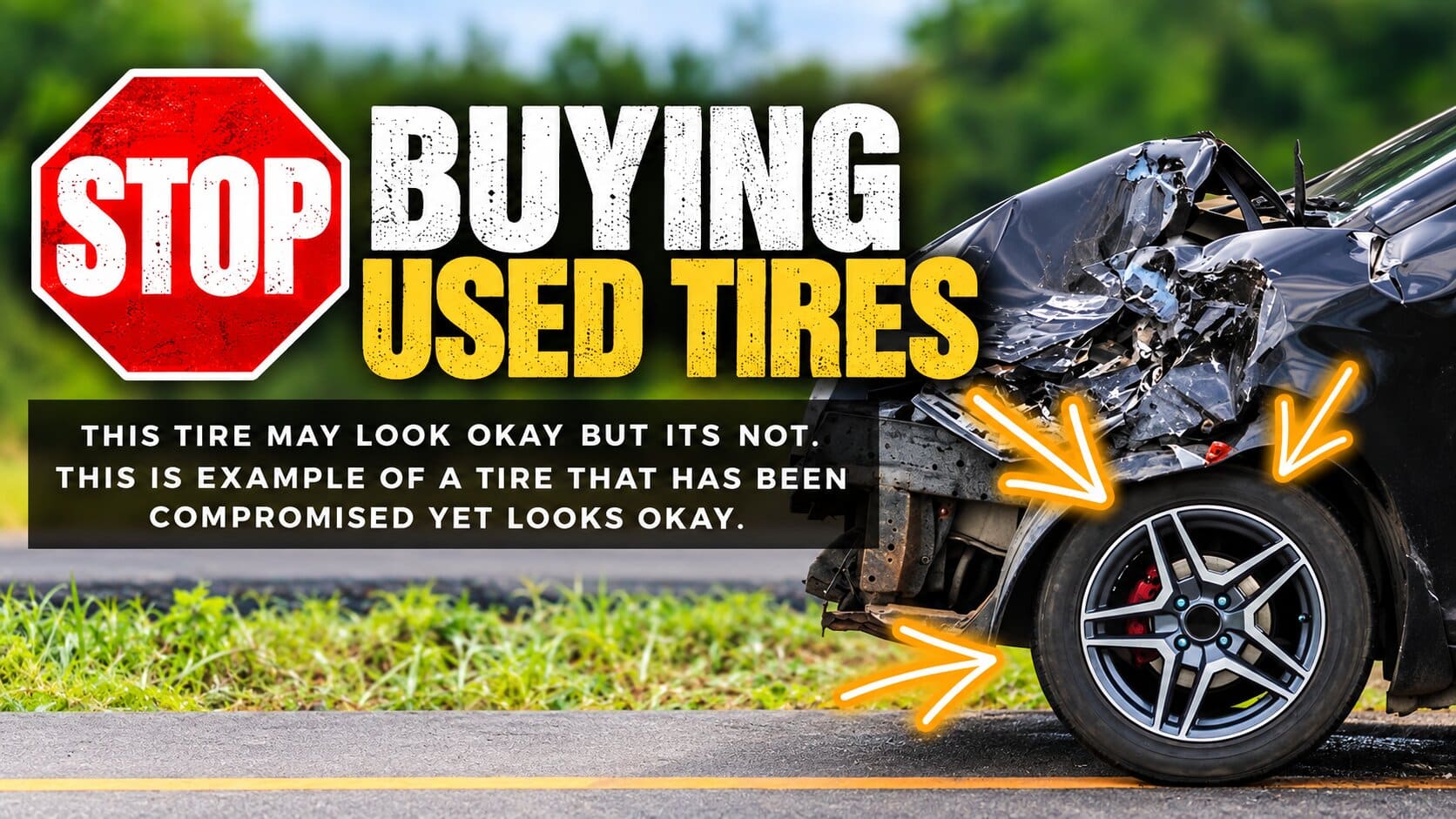
Stop Buying Used Tires! Why New Tires Can Be the Safer and Cheaper Choice in Toronto
If you are trying to save money on tires, buying used can seem like the obvious choice.
A tire that originally sold for hundreds of dollars is sitting in front of you for a fraction of the price. It still has tread. It holds air. From ten feet away, it may look almost new.
So why spend more?
Because the most important thing about a tire is not what you can see.
It is what you cannot see.
A used tire comes with a history—and unless you owned the vehicle it came from, much of that history is unknown. That uncertainty is one of the biggest reasons Toronto drivers should compare the total value of new tires rather than simply comparing the purchase price.
The problem with used tires: you don’t know where they’ve been
A tire can tell you its size, brand, model and manufacturing date.
It cannot tell you how its previous owner treated it.
Was it regularly driven underinflated?
Did it strike a pothole hard enough to damage its internal structure?
Was it repaired?
Was it driven while nearly flat?
Was it involved in a collision?
Was the vehicle badly out of alignment?
Was it stored properly?
How long did it sit unused?
That history matters because a tire is more than a piece of rubber wrapped around a wheel. Modern tires contain multiple internal layers engineered to work together while supporting thousands of pounds of vehicle weight, absorbing impacts and maintaining contact with the road.
Damage isn’t always obvious from the outside.
A used tire may look good and still have problems
One of the biggest misconceptions about used tires is that plenty of tread automatically means plenty of life.
Tread depth is important, but it is only one part of a tire’s condition.
A used tire may have:
- uneven or irregular wear
- previous puncture repairs
- sidewall damage
- cracking caused by age or environmental exposure
- internal damage from impacts
- damage caused by running at low pressure
- unknown storage conditions
- significantly less usable life than its appearance suggests
You can inspect a used tire carefully and reduce some of the uncertainty.
You cannot completely recreate its history.
That is the difference.
Tires aren’t like most used automotive parts
Buying a used vehicle does not automatically mean buying an unsafe vehicle.
Many components can be inspected, serviced, rebuilt or replaced.
Tires are different because they are consumable safety components.
Every kilometre removes a little more tread. Every heat cycle contributes to aging. Every pothole, curb strike and low-pressure drive becomes part of the tire’s history.
A used alternator either works or it doesn’t.
A used tire can continue working while gradually losing the qualities you purchased it for in the first place.
That makes price-per-tire a poor way to compare used and new tires.
A better question is:
How much am I paying for each year or kilometre of safe, useful tire life?
And that is where new tires can become surprisingly affordable.
Are used tires actually cheaper than new tires?
They can be cheaper to purchase, but not necessarily cheaper to own.
Consider a simplified example.
Imagine a new tire costs $180 and provides several years of useful service.
Now imagine a used version costs $90.
At first glance, the used tire is 50% cheaper.
But suppose much of its usable tread life is already gone.
You may have paid half the price while receiving substantially less than half of the tire’s useful life.
Then there are the additional costs.
You still have to install it.
You may still have to balance it.
You may still pay disposal fees later.
And when that tire wears out sooner, you pay those costs again when replacing it.
The purchase price is only one part of the equation.
The real calculation is cost per kilometre
Suppose, strictly as an example:
New tire
$180 purchase price ÷ 60,000 km of usable service
= $0.003 per kilometre
Used tire
$90 purchase price ÷ 20,000 km of remaining service
= $0.0045 per kilometre
The used tire costs less today.
The new tire costs less for every kilometre you actually use it.
Real tire life varies considerably based on tire model, driving habits, vehicle, alignment, inflation, road conditions and maintenance. But the principle remains important:
A lower purchase price does not automatically mean a lower ownership cost.
New tires give you 100% of the product you’re paying for
When you buy a brand-new tire, you are buying the tire at the beginning of its usable life.
You know its starting tread depth.
You know it hasn’t been driven thousands of kilometres by someone else.
You aren’t inheriting another driver’s wear pattern.
You can maintain it properly from day one.
And eligible new tires generally include the manufacturer’s applicable warranty coverage.
That provides something that is difficult to put a dollar value on:
predictability.
When four new tires are installed together, you can rotate them appropriately, monitor their pressure and track their wear throughout their life.
Instead of guessing what happened before you bought them, you control what happens next.
Used premium tires aren’t always better than new budget tires
This is another mistake Toronto drivers sometimes make.
You may see a recognizable premium-brand used tire beside a less expensive new tire and automatically assume the premium brand is the better purchase.
Not necessarily.
Brand matters.
Tire model matters.
Performance characteristics matter.
But condition matters too.
A partially worn premium tire with an unknown history cannot be compared solely by brand name against a brand-new tire.
For a driver working with a limited budget, a reputable new entry-level tire can sometimes provide a stronger overall value proposition because you receive its complete usable life rather than purchasing whatever life remains.
That’s why shopping for tires should involve more than asking:
“What’s the cheapest tire?”
Instead ask:
“What is the best new tire available within my budget?”
That is a much more useful question.
Toronto roads make tire condition especially important
Drivers looking for tires in Toronto experience conditions that can be demanding on tires.
Our vehicles encounter summer heat, heavy rain, freezing temperatures, snow, slush, potholes and repeated freeze-thaw cycles.
A tire doesn’t get an easy life here.
And during winter, the four relatively small contact patches connecting your vehicle to the road are responsible for acceleration, braking and steering.
This is why knowing the condition of your tires matters.
A tire’s appearance in a classified advertisement cannot tell you how it will perform during an emergency stop on a cold, wet Toronto morning.
What about buying four used tires instead of one?
Buying four matching used tires may eliminate some problems associated with mixing different tire models or drastically different tread depths.
It does not eliminate the unknown history.
You still need to determine:
- manufacturing dates
- remaining tread
- whether repairs have been performed
- whether wear is even
- whether there is cracking or visible damage
- whether all four tires actually match
- whether they are appropriate for your vehicle
- how much useful service life remains
This becomes particularly important with AWD and performance vehicles, where differences in tire circumference or tread depth can create additional concerns.
What if I only need one tire?
There are situations where replacing one tire is necessary.
But the replacement needs to be compatible with the other tires already installed on the vehicle.
Tire size, construction, category, tread depth and vehicle drivetrain can all affect whether replacing only one tire makes sense.
At Black Tires, single new tires are available for pickup, so Toronto drivers who don’t need a complete set aren’t automatically forced into buying four tires.
For AWD vehicles in particular, check your vehicle manufacturer’s specifications before replacing only one tire.
New tires can save money by delaying your next tire purchase
This is one of the simplest advantages of buying new.
Suppose a used set needs replacing in two years while a properly maintained new set continues serving you considerably longer.
With the used tires, you’re shopping again.
Paying again.
Installing again.
Balancing again.
Disposing again.
The cheaper transaction may simply move your next expense closer.
A new set spreads its purchase cost across the tire’s entire usable life.
For drivers who plan to keep their vehicle, that can make new tires considerably more cost-effective than they initially appear.
There is another overlooked benefit: you can maintain new tires correctly from day one
Tire longevity isn’t predetermined.
Drivers influence it.
Regular tire rotations, proper inflation, wheel alignment and inspections can help prevent premature or uneven wear.
When you buy new tires, you have the opportunity to manage the entire ownership cycle.
You know when they were installed.
You know their starting condition.
You know their service history.
You can monitor tread wear.
You can keep your records.
That makes it easier to maximize the value of your investment.
With used tires, part of that service life has already occurred outside your control.
New tires don’t necessarily mean expensive tires
This may be the biggest reason the used-tire conversation has changed.
Toronto drivers now have a wide range of new tire choices across multiple price points.
There are premium tires.
Mid-range tires.
Value-focused tires.
Winter tires.
All-weather tires.
All-season tires.
Performance tires.
SUV and light-truck tires.
The right answer isn’t automatically the most expensive tire in the warehouse.
The goal is to find a new tire appropriate for your vehicle, driving habits and budget.
A driver who travels mainly through Toronto may need something different from a driver commuting long distances every day.
A BMW driver may have different requirements from a Honda Civic driver.
A Range Rover owner may have different needs from someone driving a compact sedan.
That is why comparing tires based on total value is more useful than simply comparing brands.
Used tires vs. new tires: the simple comparison
| Used Tires |
New Tires |
| Lower initial price |
Higher initial price |
| Unknown previous use |
Known condition from installation |
| Partial tread life |
Full usable tread life |
| Possible previous repairs |
No previous road-use repairs |
| Unknown maintenance history |
You control maintenance from day one |
| May need replacement sooner |
Longer potential ownership period |
| Warranty protection may be limited or unavailable |
Eligible tires include applicable manufacturer warranty |
| Lower upfront cost |
Potentially better cost per kilometre |
The cheapest tire today and the cheapest tire over several years can be two completely different things.
Frequently Asked Questions About Used Tires in Toronto
Are used tires safe?
Some used tires may still be serviceable, but their previous use, maintenance and storage history can be difficult to verify. Any used tire should be thoroughly inspected by a qualified tire professional before installation.
Is it better to buy cheap new tires or premium used tires?
It depends on the specific tires involved, but a new value-oriented tire gives you its full usable life and known starting condition. Those factors should be considered alongside brand reputation and performance.
How can I tell how old a tire is?
The tire’s DOT code includes information that identifies its manufacturing date. Tire age should be evaluated together with condition, usage and manufacturer recommendations.
Do new tires come with warranties?
Many new tires include applicable manufacturer warranty coverage. Terms differ by manufacturer and tire model, so always check the specific warranty.
Where can I buy new tires in Toronto?
Black Tires supplies new tires throughout Toronto and the GTA, with options ranging from budget-focused tires to premium brands. Customers can view pricing online before requesting an appointment.
Does Black Tires sell used tires?
No. Black Tires sells new tires only.
The focus is helping customers find new tires at competitive prices without taking on the uncertainty associated with a tire’s previous ownership.
Before searching “used tires near me,” compare the real numbers
Nobody likes spending more money than necessary.
But saving money isn’t about choosing the lowest number on a price tag.
It’s about getting the most value from every dollar you spend.
A $90 tire that needs replacing much sooner isn’t necessarily more affordable than a $180 tire that gives you years of additional service.
And when the product is responsible for keeping your vehicle connected to the road, condition matters just as much as price.
So before buying someone else’s remaining tread life, compare the cost of starting with 100% of your own.
Looking for new tires in Toronto?
Black Tires offers brand-new manufacturer-warrantied tires for drivers throughout Toronto and the Greater Toronto Area.
Compare options for your vehicle and see exactly what your purchase will cost before booking.
See your Out The Door Price instantly at BlackTires.ca
Shop tires: BlackTires.ca/tire-quote-toronto/
New tires. Clear pricing. No guessing about where they’ve been.