
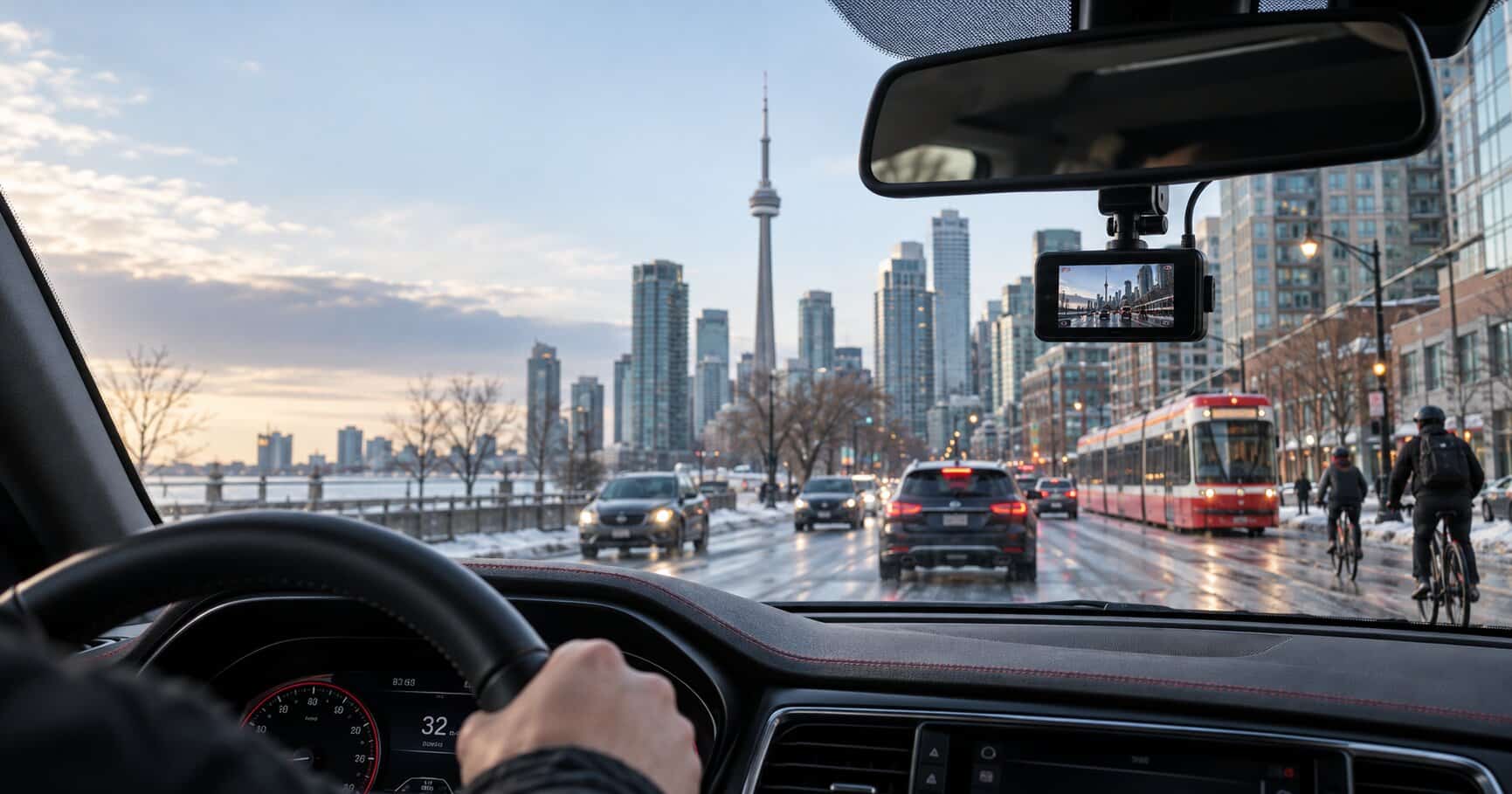
9 Benefits of Having a Dash Cam in Toronto
By Black Tires Distribution · Fact-checked September 7, 2026
Toronto drivers deal with almost every kind of road environment: crowded downtown intersections, streetcars, cyclists, pedestrians, busy parking lots, Highway 401 traffic, the Gardiner Expressway, the Don Valley Parkway and rapidly changing winter weather.
A dash cam cannot prevent a collision or replace careful driving. What it can do is create an independent record of the seconds that are often hardest to reconstruct afterward. That makes the case for using a dash cam in Toronto especially strong.
That matters when two drivers remember an incident differently, no witness stops, a vehicle leaves the scene or damage appears while your car is parked. For many Toronto and GTA drivers, a reliable dash camera is a practical layer of protection rather than just another electronic accessory.
Quick answer: A dash cam can preserve collision evidence, help clarify conflicting insurance accounts, identify a hit-and-run vehicle, expose staged incidents, monitor a parked car, assist an investigation, protect professional drivers, record road conditions and support safer-driving reviews. It does not decide fault by itself or guarantee an insurance discount.
Dash cams are already normal in major cities around the world
Toronto is not leading this trend. Dashboard cameras became familiar much earlier in several large international markets:
- Seoul and other South Korean cities: Dash cams are commonly called “black boxes.” A 2019 South Korean survey cited by The Straits Times found that 88.9 per cent of drivers used one, while academic research from KAIST has described adoption as exceeding 60 per cent.
- Moscow and other Russian cities: Russia became one of the earliest major dash-cam markets, driven in part by drivers wanting evidence for collision, insurance and fraud disputes, as this background report from Time explains.
- London and other UK cities: Aviva estimated in 2018 that 10.9 million UK drivers, or 27 per cent, were already using dash cams. Police programs such as Operation Snap also accept road-incident footage from the public in many parts of the UK.
- Singapore: The Singapore Law Gazette described in-vehicle cameras as being present in almost every vehicle and discussed their value when a driver’s memory and video evidence differ.
- Sydney, Melbourne and other Australian cities: A 2025 Australian survey reported by ABC News found that 26 per cent of respondents had a dash cam and another 15 per cent were considering one.
The precise adoption rate varies by source and country, but the direction is clear: in dense cities where claims, parking damage and disputed road incidents are common concerns, dash cams have become mainstream.
1. A dash cam gives you an independent record of a collision
After a crash, stress can make small but important details difficult to remember. A properly positioned dash cam may record:
- The colour of a traffic signal
- Which vehicle entered an intersection first
- Lane position and lane changes
- A sudden stop or unsafe turn
- Brake lights and following distance
- Road, lighting and weather conditions
- The sequence of multiple impacts
Video does not automatically decide fault, and it only shows the camera’s field of view. However, it can preserve details that vehicle damage, memory and statements alone may not settle.
2. Footage may make an insurance claim easier to evaluate
Ontario insurers apply the province’s Fault Determination Rules when assessing responsibility for many collisions. Insurers can consider statements, photographs, witness information, police reports and available video. Belairdirect explains that an adjuster may review dash-cam footage with other evidence when applying provincial fault rules.
A clear, complete clip can therefore help an adjuster understand what happened when accounts conflict. It does not guarantee that you will be found zero per cent at fault, that a claim will be paid or that the process will be immediate. The same recording may also show your own speed, following distance, distraction or driving error.
Another important distinction: Canadian insurers do not generally advertise a standard premium discount simply for installing a dash cam. Its financial value is more likely to come from the evidence it preserves than from an automatic monthly discount. Ask your own insurer before assuming otherwise.
3. It can capture details after a hit-and-run
When another driver leaves the scene, useful details disappear quickly. Depending on the camera angle, lighting and motion, footage may capture the vehicle’s:
- Licence plate
- Make, model and colour
- Direction of travel
- Distinctive damage or markings
- Driver behaviour before and after contact
No camera can promise a readable plate in every condition. Night glare, dirty glass, snow, speed and a wide field of view can all reduce detail. This is why image quality and low-light performance matter more than a large “4K” label on an unknown product.
4. A dash cam can help expose staged collisions and false accounts
The Financial Services Regulatory Authority of Ontario warns that staged collisions are real: a fraudster may cut in front of an unsuspecting driver and brake suddenly in hopes of being rear-ended. FSRA advises drivers to photograph the scene, record as much information as possible and file a police report.
A continuously recording dash cam may preserve the manoeuvre that happened before impact. It can also challenge a false account of who changed lanes, who reversed or how the collision began. Footage is not a substitute for exchanging information, taking photographs, finding witnesses and reporting the incident when required.
5. Parking mode may document damage while you are away
Toronto parking can be tight. A front-and-rear system with a properly configured parking mode may record a vehicle that bumps your car, someone who vandalizes it or activity around an attempted theft.
Parking mode is not automatic on every installation. It usually requires a compatible hardwire kit or dedicated dash-cam battery, and it should include low-voltage protection so the system does not leave your vehicle unable to start. This is especially important during a Toronto cold snap, when a weak 12-volt battery already has less reserve.
Even a good parking setup has blind spots. A two-channel camera normally watches the front and rear, not every side of the vehicle.
6. Your recording may help witnesses, police and other road users
Your camera may capture an incident that does not directly involve your vehicle. Toronto Police regularly asks residents, businesses and drivers for security or dash-camera footage when investigating serious incidents and collisions.
Video may help identify a dangerous driver, reconstruct a road-rage event or establish what happened to a pedestrian, cyclist or motorcyclist. If the situation is urgent or someone is at risk, call 911. For a non-emergency, follow Toronto Police reporting instructions and let investigators tell you how to provide the original file.
Do not pursue another vehicle to get better footage. A dash cam should reduce your risk, not encourage a confrontation.
7. It provides extra protection for rideshare, delivery and fleet drivers
People who spend more hours on the road have more exposure to collisions, passenger disputes and complaints. A front-and-rear camera can document the road around a work vehicle, while a three-channel system can also record the cabin.
Cabin recording requires additional care. The federal Office of the Privacy Commissioner has found that continuous audio and video monitoring inside commercial truck cabs can be unreasonably intrusive. Fleet owners should have a clear purpose, provide notice, limit collection, control access and retention, and obtain legal or privacy advice before introducing driver-facing cameras.
For rideshare drivers, a visible notice and a camera with an easy microphone-off control are sensible starting points. Platform rules should also be checked before installation.
8. It preserves road and weather context that photographs may miss
Freezing rain, blowing snow, standing water, sun glare, construction, debris and damaged pavement can all affect an incident. Photographs taken afterward may not show how quickly conditions changed or where a hazard first appeared.
A dash cam records the approach, not only the final position of the vehicles. That context can be valuable to an insurer, police investigator or lawyer assessing the complete event.
Toronto’s Vision Zero Road Safety Plan focuses on preventing deaths and serious injuries involving vulnerable road users, aggressive driving and distracted driving. Camera footage cannot make the streets safe on its own, but responsible drivers can preserve evidence that supports accurate investigations.
9. Reviewing footage can improve driving habits
A dash cam can also be a coaching tool. Families, new drivers and fleet managers can review a close call and ask practical questions:
- Was the following distance long enough?
- Did the driver check the bike lane before turning?
- Was speed appropriate for snow or rain?
- Was the vehicle positioned well before a lane change?
- Did distraction delay the driver’s reaction?
This benefit depends on using footage constructively. Constant surveillance without a clear policy can damage trust, particularly in a workplace.
Two dash cams worth considering on Amazon.ca
Affiliate disclosure: As an Amazon Associate I earn from qualifying purchases. If you buy through the affiliate links below, Black Tires may receive a commission at no additional cost to you.
These are research-based recommendations using current Amazon.ca listings, manufacturer specifications and independent evaluations. Prices, sellers, bundles and availability can change, so the article does not hard-code a price.
Best-value front-only option: VIOFO A119 Mini 2
The VIOFO A119 Mini 2 is a strong fit for a Toronto commuter who wants a compact, discreet camera without paying for a rear channel. It records 2K video at up to 60 frames per second and can use HDR at 30 frames per second. Its Sony STARVIS 2 sensor is designed for better detail in difficult lighting, and it includes GPS, dual-band Wi-Fi, voice control and a supercapacitor.
Its buffered parking mode can save footage from before and after a detected event, but VIOFO states that parking mode requires a separately sold hardwire cable.
Best for: Drivers who want reliable front coverage, good night performance and a less complicated installation.
Main limitation: It does not record behind the vehicle.
Amazon.ca product: Check the VIOFO A119 Mini 2 on Amazon.ca (replace with Black Tires SiteStripe affiliate link before publishing)
Stronger front-and-rear option: VIOFO A229 Pro 2CH
The VIOFO A229 Pro 2CH is the more complete choice. It records in 4K at the front and 2K at the rear, with Sony STARVIS 2 sensors and HDR on both channels. It also offers GPS, dual-band Wi-Fi, voice control and buffered parking modes when installed with the separately sold hardwire kit.
Front-and-rear recording is particularly useful in Toronto traffic because the cause of an incident may begin behind you even when the impact happens at the front or side. The tradeoff is a higher purchase price, more wiring and larger video files.
Best for: Drivers who want higher-detail evidence and coverage in both directions.
Main limitation: Installation is more involved, and a suitable high-endurance memory card should be budgeted for.
Amazon.ca product: Check the VIOFO A229 Pro 2CH on Amazon.ca (replace with Black Tires SiteStripe affiliate link before publishing)
What to look for when buying a dash cam for Toronto
Clear video, not just a large resolution claim
Choose a known model with real sample footage. A useful camera must handle movement, darkness, bright headlights and reflective licence plates. A reputable 2K camera can be more useful than a low-quality product advertising “4K.”
HDR and good night performance
Toronto drivers spend plenty of time in darkness, underground parking, rain and winter glare. HDR can help balance bright and dark parts of the image, although it cannot overcome every difficult angle or reflection.
Front-and-rear coverage when the budget allows
A front camera is far better than no camera. A rear camera adds context for tailgating, rear impacts and events that begin behind you. Rideshare drivers may consider a third, inward-facing channel after addressing passenger and worker privacy properly.
A supercapacitor
Dash cams built around a supercapacitor are generally preferable to models relying on a small lithium battery for in-car use. The camera still needs vehicle power; the supercapacitor is mainly there to shut down properly and save the current file.
A high-endurance microSD card
Continuous recording is hard on ordinary memory cards. VIOFO recommends at least 64 GB, suggests 128 GB or 256 GB for longer trips or commercial use, and advises using a card designed for repeated dash-cam recording. Check the exact model’s compatibility list before buying.
Parking-mode power with low-voltage protection
If parked recording matters, include the hardwire kit or dedicated battery in your total budget. Have wiring routed away from airbags and confirm that the low-voltage cutoff is appropriate for the vehicle and Toronto winter use.
Easy clip retrieval
Wi-Fi, a clear app and a removable card make it easier to save a file before loop recording overwrites it. Test the process before an emergency.
Are dash cams legal in Toronto and Ontario?
Dash-cam use is generally permitted in Ontario, but installation and operation still matter.
Section 73 of Ontario’s Highway Traffic Act prohibits objects placed or attached in a way that obstructs the driver’s view of the highway or an intersecting highway. Mount the camera high and close to the rear-view mirror, where it does not create a new blind spot. Do not place it where wiring interferes with an airbag.
Set the screen to turn off after setup and do not handle the camera or use its app while driving. Transport Canada’s guidance says visual displays should not interfere with the view or show moving video to the driver while the vehicle is in motion.
Audio deserves special attention. Section 184 of Canada’s Criminal Code includes an exception where the originator or intended recipient of a private communication consents to interception—often described as one-party consent. That does not make every unattended, passenger or workplace recording risk-free. The safest everyday practice is to turn cabin audio off when it is unnecessary, tell passengers when it is on and obtain specific advice for commercial monitoring.
Finally, recording an incident is different from publishing it. Give relevant footage to your insurer, police or legal adviser. Avoid posting identifiable people, private conversations or an unresolved collision to social media without considering privacy, defamation and evidentiary consequences.
What to do with dash-cam footage after a collision
- Look after safety first. Move out of danger if it is safe and legal to do so, check for injuries and call 911 when required.
- Lock or save the recording. Preserve several minutes before and after the event, not only the moment of impact.
- Continue normal documentation. Photograph the scene and damage, exchange driver and insurance information, and collect witness details.
- Keep the original file. Make backup copies, preserve the memory card if the incident is serious and do not edit or add captions to the evidentiary copy.
- Report the collision when required. Toronto Police says collisions involving injury, combined damage above $5,000, or damage to private, municipal or highway property must be reported as soon as possible. Check the current Toronto collision-reporting instructions, because thresholds and procedures can change.
- Tell the insurer that footage exists. Ask how it should be submitted. If injuries, criminal allegations or a major dispute are involved, obtain legal advice before publishing or discarding anything.
The bottom line: is a dash cam worth it in Toronto?
For most drivers, yes—a reliable, properly installed dash cam is worth considering. It cannot stop another driver from making a mistake, guarantee a readable licence plate or decide an insurance claim by itself. Its real value is simpler: it can preserve an independent account when the facts matter most.
A dash cam helps document what happened. Good tires, correct pressure and adequate tread help your vehicle respond before it happens. If your tires are worn or unsuitable for the season, compare brand-new tires and see your Out The Door Price through Black Tires. For practical maintenance guidance, see Tire Care 101.
Frequently asked questions about dash cams in Toronto
Does a dash cam automatically prove who was at fault?
No. It is one piece of evidence with a limited field of view. Insurers, police and courts may also consider Ontario’s fault rules, statements, witnesses, physical damage, photographs and other evidence.
Can dash-cam footage be used against the owner?
Yes. A recording may show the owner speeding, following too closely, using a device or otherwise contributing to an incident. Preserve the complete original recording rather than presenting a misleading excerpt.
Will installing a dash cam lower my Ontario insurance premium?
Do not assume it will. Canadian insurers generally do not promote a standard dash-cam discount. Ask your insurer directly. The main potential benefit is useful evidence after an incident.
Is a front-only dash cam enough?
It covers the most important direction and is a sensible starting point. A front-and-rear system gives more context and may capture a rear impact or the actions of a vehicle approaching from behind.
Will a dash cam record while the car is off?
Only if the camera supports parking mode and has an appropriate power source. Many systems require a separate hardwire kit or dash-cam battery. Configure low-voltage protection carefully.
How often should I check my dash cam?
Check that it powers on and records at least monthly, review a sample day and night clip, confirm the date and time, and follow the manufacturer’s instructions for formatting and replacing the memory card. A camera that silently stopped recording offers no protection.